I Met Mike Holt at NECA 2026 — And It Reminded Me Why Electricians Never Stop Learning
Every once in a while, something happens in this trade that just sticks with you.
I recently went to the NECA Convention in Las Vegas, and while there I got to spend some time around a lot of people who have been involved in the electrical industry for a long time. There were manufacturers, contractors, educators, new products, code discussions, and more electrical technology in one place than you could probably see in several years of normal day-to-day work.
Then something happened that I honestly did not expect.
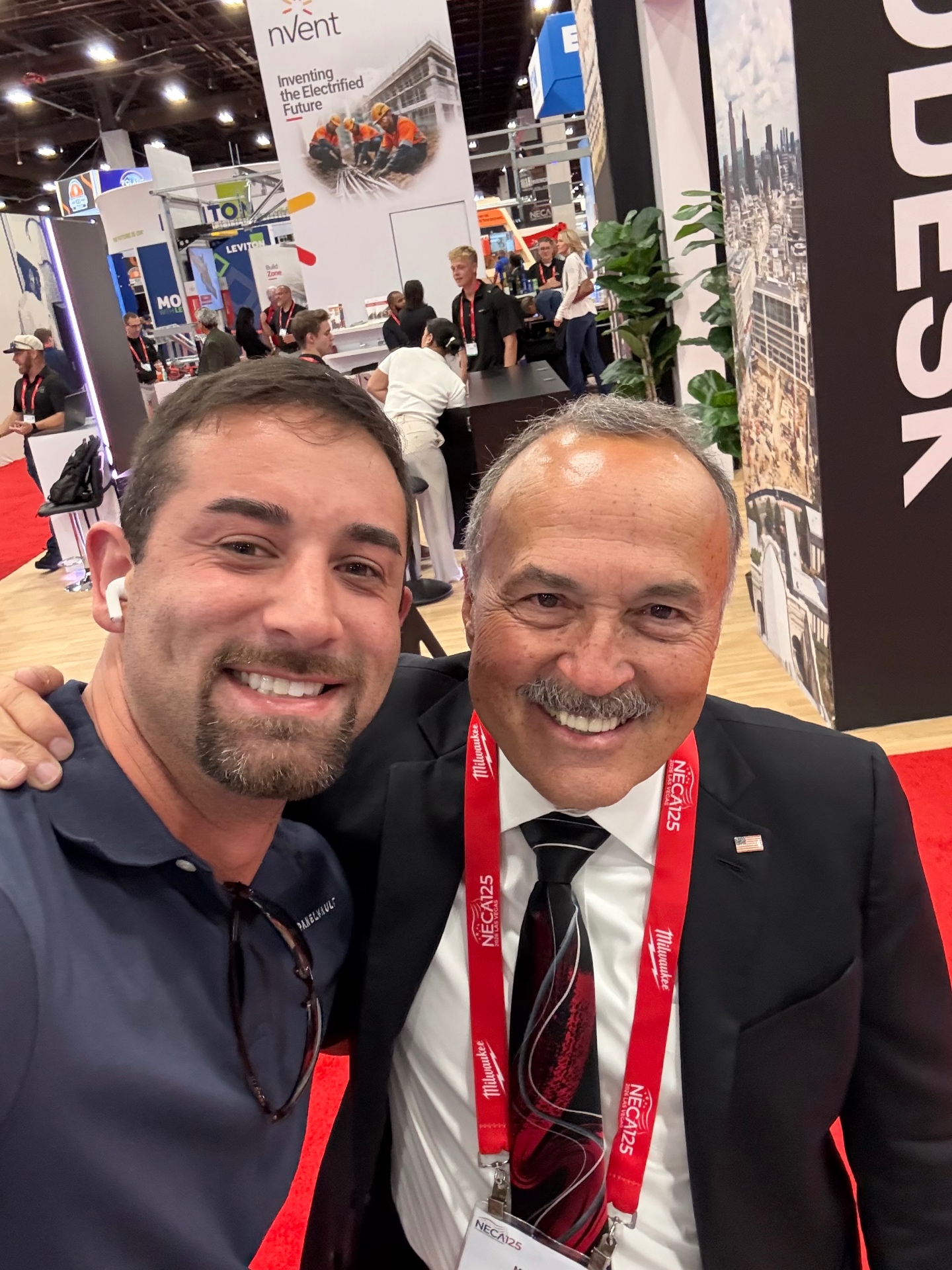
Mike Holt came up to me personally, put his arm around me, introduced himself, and we stood there laughing and talking for a good while.
My first response to him was, “Hey, you’re the guy that caused me to fail my electrical license test.”
He laughed, I laughed, and we had a good conversation after that.
For anybody outside the electrical industry, that probably does not sound like a big deal. But if you are an electrician, especially if you have spent time studying electrical theory, grounding and bonding, code calculations, or preparing for a license exam, there is a very good chance you have come across Mike Holt’s material at some point.
His training programs have been used for years by electricians studying electrical theory, National Electrical Code requirements, licensing exams, grounding and bonding, and continuing education. Mike Holt Enterprises is already offering training centered around the 2026 National Electrical Code and its major changes, which is a good example of how quickly the electrical trade continues moving forward.
Getting a picture with him was cool, but the conversation itself reminded me of something that matters a lot more.
No electrician ever gets to the point where there is nothing left to learn.
Passing the Electrical Exam Is Really Just the Beginning
When you are studying for an electrical license, it can feel like passing that test is the finish line.
You study calculations, conductor sizing, grounding, bonding, services, feeders, motors, transformers, overcurrent protection, voltage drop, box fill, and what sometimes feels like an endless amount of electrical code.
Then you take the exam.
If you pass, you finally feel like you made it.
But after working in the trade long enough, you realize that passing the test was really just the beginning.
A license proves that you met a certain standard at a certain point in time. It does not mean you suddenly know everything there is to know about electricity.
Nobody does.
Electrical systems are too broad for that.
One day you may be troubleshooting an old house with wiring that has been modified five different times over 70 years. The next day you may be installing a modern 200-amp service, an EV charger, generator equipment, surge protection, or working around sophisticated commercial equipment.
The fundamentals stay important, but the equipment and applications continue changing.
Electrical Code Is Always Changing
One reason electricians have to keep learning is simple: the National Electrical Code keeps changing.
New technology comes along.
New hazards are identified.
Installation methods change.
Manufacturers develop new equipment.
The Code changes to address those conditions.
The 2026 NEC includes changes involving areas such as services, branch circuits, grounding and bonding, energy management, overvoltage protection, vehicle power transfer systems, and other electrical systems that electricians increasingly deal with in the field.
That is why an electrician cannot simply learn one edition of the Code and assume that knowledge will carry forever.
The principles stay with you, but the details have to stay current.
Why Code Changes Matter to Homeowners
A homeowner may wonder why any of this matters to them.
If your house already has electricity, why should you care what changed in the newest electrical code?
Because electrical code is not just a collection of random rules created to make an electrician’s job harder.
Many requirements exist because electrical systems have failed in certain ways before.
People have been shocked.
Equipment has overheated.
Fires have happened.
Technology has changed.
Better ways of protecting people and property have been developed.
Code requirements evolve along with that knowledge.
That does not mean every old electrical installation instantly becomes unsafe every time a new Code book is released. Existing installations are often evaluated differently from new work.
But when new electrical work is performed, understanding current requirements matters.
Experience Is Important, but Experience Alone Is Not Enough
I believe strongly in experience.
There are things you learn in the field that no book can fully teach you.
You learn what overheated electrical equipment looks like.
You learn what a bad connection smells like.
You learn how old houses were commonly wired.
You learn how to troubleshoot a circuit efficiently.
You learn how different panels are built.
You learn what happens when water gets into electrical equipment.
You learn how to plan a service installation so it is not only code-compliant but also clean, accessible, and practical.
Those lessons matter.
But experience can become a problem if somebody starts believing:
“I’ve been doing this for 30 years, so nobody can teach me anything.”
That is a dangerous attitude in any technical trade.
If you have been doing something the same way for 30 years, there is a real possibility that the equipment, standard, or requirement has changed during those 30 years.
Good experience should make you more willing to learn, not less.
The Electrical Trade Is Changing Faster Than Ever
Think about what residential electrical work looked like not that long ago.
A typical home had lighting, receptacles, a range, water heater, dryer, and heating or cooling equipment.
Now consider what may be connected to a modern house.
EV chargers.
Whole-home generators.
Battery storage.
Solar systems.
Smart electrical panels.
Load-management systems.
Heat pumps.
Variable-speed HVAC equipment.
Electronic appliances.
Home automation.
Surge protective devices.
Networked equipment.
Pools and spas.
Outdoor kitchens.
Workshops.
Electric tankless water heaters.
Home offices filled with electronics.
The electrical service supplying a modern house has to accommodate equipment that was not common in residential work a generation ago.
That means electricians have to understand more than just wiring a light switch.
EV Chargers Are a Great Example
Electric vehicles are a perfect example of why continuing education matters.
An EV charger can represent a substantial electrical load.
You cannot simply look at an empty breaker space and assume the house can handle another large load.
The existing electrical service may need to be evaluated.
A load calculation may be needed.
Conductor size matters.
Breaker size matters.
Equipment ratings matter.
The charger location matters.
Newer energy-management technology may sometimes allow a different solution than simply increasing the service size.
Those options continue evolving.
An electrician who refuses to keep learning may not even know some of those options exist.
Generators Have Changed Too
Generators are another area where electrical knowledge matters.
A generator installation involves much more than connecting a few wires.
Transfer equipment matters.
Neutral configuration matters.
Grounding and bonding matter.
Service equipment configuration matters.
Generator capacity matters.
Load management may matter.
Depending on the system, the generator may automatically start, transfer loads, manage selected circuits, and communicate with other equipment.
Installing that correctly requires understanding both electrical principles and the specific equipment being installed.
Surge Protection Has Become More Important
Modern homes contain more sensitive electronics than ever before.
HVAC control boards, refrigerators, washing machines, ranges, televisions, computers, garage door openers, security systems, smart-home equipment, and countless other devices contain electronics.
That is one reason surge protection has become an increasingly important part of electrical installations.
The current NEC includes dedicated overvoltage protection requirements and continues expanding how surge protective devices are incorporated into electrical systems.
This is another area where something that used to be viewed as an optional upgrade has become much more common in modern electrical design.
Grounding and Bonding Never Stop Being Important
If there is one subject in electrical work that can humble almost anybody, it is grounding and bonding.
It is also an area where Mike Holt has spent a tremendous amount of time educating electricians.
His current 2026 grounding and bonding materials alone include hundreds of pages, illustrations, and practice questions because the subject is more complicated than simply driving a rod into the ground.
Grounding and bonding affect services, separately derived systems, generators, transformers, detached buildings, metal piping, electrical equipment, and fault-current paths.
It is one of those subjects where understanding why something is done matters much more than memorizing a rule.
Memorizing the Code Is Not the Same as Understanding Electricity
This is something I learned while studying for my own electrical license.
You can memorize a lot of code sections and still struggle when a real-world electrical problem is standing in front of you.
On the other hand, somebody may understand electrical theory extremely well and still need to look up a specific code requirement.
The best electricians need both.
You need to understand the electrical theory behind the system, and you need to know how to find and correctly apply the rules that govern the installation.
Nobody should be embarrassed about opening a Code book.
Nobody should be embarrassed about checking manufacturer instructions.
The dangerous person is the one who does not know but pretends that he does.
Manufacturer Instructions Matter More Than People Realize
Another major part of modern electrical work is understanding the equipment itself.
An electrician may install equipment from dozens of different manufacturers over the course of a year.
Different panels.
Different transfer switches.
Different EV chargers.
Different generators.
Different surge protectors.
Different lighting systems.
Different disconnects.
Different electronic controls.
Nobody can reasonably memorize every installation requirement for every product ever manufactured.
That is why manufacturers provide instructions and why listed electrical equipment has specific installation requirements.
Reading the instructions is not a sign that somebody does not know what they are doing.
Often, it is exactly the opposite.
A Good Electrician Knows When to Verify Something
There is a big difference between experience and guessing.
An experienced electrician develops judgment about when something is familiar and when something deserves another look.
Maybe it is an unusual service configuration.
Maybe it is a generator with a switched neutral.
Maybe it is a new type of EV equipment.
Maybe it is a conductor derating question.
Maybe it is a panel that has equipment-specific requirements.
Sometimes the correct answer is:
“I want to verify that before I tell you.”
I respect that a lot more than somebody confidently giving the wrong answer.
Electricity does not care how confident you were.
Electrical Training Is Different When You Have Field Experience
Something interesting happens as you get farther into the trade.
The same electrical class means something different after you have actually seen the equipment in the field.
When you are new, you may read about an open neutral and understand the theory.
Then one day you walk into a house where the lights on one side are extremely bright and the lights on the other side are dim.
Now the lesson sticks.
You learn about loose electrical connections creating resistance and heat.
Then you open a panel that has been severely arcing.
Now it sticks.
You learn about grounding and bonding.
Then you troubleshoot a system where somebody bonded the neutral and ground in the wrong location.
Now it sticks.
Experience gives the education context.
Education gives the experience explanation.
The two work together.
That Is What Made Meeting Mike Holt So Funny to Me
That is probably why meeting Mike Holt made me laugh as much as it did.
Years ago, when I was studying, some of that material could make you want to throw the book across the room.
Calculations that seemed impossible.
Questions that made you second-guess yourself.
Code rules where one word changed the entire answer.
Then years later, the same guy whose material helped make that test difficult walks up to you in Las Vegas, throws his arm around you, and starts talking to you like you have known each other for years.
So naturally I told him:
“You’re the guy that caused me to fail my electrical license test.”
We both laughed.
And honestly, I would not change it.
Those difficult parts of learning the trade are part of what makes you better.
Licensing Tests Are Supposed to Be Difficult
Nobody wants an electrical licensing exam to be easy enough that anyone can walk in without preparation and pass it.
An electrician works around equipment capable of starting fires, damaging expensive equipment, seriously injuring someone, or killing someone.
That sounds dramatic, but it is true.
Electrical work involves responsibility.
A licensing test cannot prove that someone is a perfect electrician, but it can help establish that a person understands a certain level of theory, code, and electrical knowledge.
Then the real learning continues in the field.
There Is No Shame in Having to Learn Something Twice
Electrical work is too broad to remember every detail forever.
You may fully understand something today and then not deal with that particular application again for five years.
When it comes up again, you refresh yourself.
That is normal.
The important thing is knowing where to find reliable information and being willing to use it.
The Code book.
Manufacturer documentation.
Electrical training.
Industry publications.
Continuing education.
Other qualified professionals.
Those resources exist for a reason.
Conventions Like NECA Let You See Where the Industry Is Going
One of the coolest parts about attending an electrical convention is seeing things before they become normal on everyday jobs.
Manufacturers are showing new equipment.
Contractors are talking about the challenges they are facing.
Educators are discussing code changes.
New technologies are being demonstrated.
You begin to see where electrical work is headed.
Things that seem unusual today may be completely standard ten years from now.
That happened with LED lighting.
It happened with whole-home surge protection.
It is happening with EV charging and energy management.
Battery systems and smart electrical distribution will continue changing things too.
New Technology Does Not Make the Fundamentals Less Important
For all the new technology at an electrical convention, something becomes very obvious.
The fundamentals still matter.
Ohm's law still matters.
Conductor sizing still matters.
Overcurrent protection still matters.
Voltage drop still matters.
Grounding and bonding still matter.
Proper terminations still matter.
Torque still matters.
Working clearances still matter.
Electrical safety still matters.
Technology gets more complicated, but it still sits on top of basic electrical principles.
If the foundation is wrong, fancy equipment does not fix it.
Workmanship Still Matters
You can know every Code section in the book and still do ugly work.
And something can look beautiful while being electrically wrong.
The goal is both.
A good installation should be safe, code-compliant, serviceable, and clean.
Conduit should make sense.
Equipment should be accessible.
Conductors should be terminated correctly.
Panels should be labeled.
Work should look like somebody cared about what they were doing.
I believe workmanship says a lot about how someone approached the parts you cannot see.
Homeowners Should Ask Questions
Homeowners should never feel like they are bothering an electrician by asking why something is being done.
A good electrician should be able to explain the basic reasoning behind the work.
Why does this service need upgrading?
Why are the neutral and ground separated here?
Why is surge protection being installed?
Why does the EV charger need this conductor size?
Why does this panel need working clearance?
Why can we not simply put the meter wherever we want?
There may be technical details the homeowner does not need to memorize, but explaining the reasoning builds trust.
I would rather have somebody understand what they are paying for than simply tell them:
“That’s code.”
The Best Electricians Are Still Students
The longer I work in this trade, the more I believe this.
The electrician who thinks he knows everything is probably the electrician who has stopped improving.
There is always another piece of equipment.
Another unusual wiring method.
Another troubleshooting problem.
Another Code change.
Another manufacturer.
Another technology.
Another mistake someone else made that you have never seen before.
You keep learning because the work keeps changing.
Bringing What You Learn Back Home
Las Vegas is a long way from Rogersville, Tennessee.
The NECA convention is full of enormous displays, major manufacturers, industry leaders, and technology from across the electrical world.
But the real value is what comes back home with you.
Maybe it is a better way to approach an installation.
Maybe it is new equipment you did not know existed.
Maybe it is a better understanding of an electrical code requirement.
Maybe it is simply the reminder that no matter how long you have been doing this, there are people you can still learn from.
That ultimately affects the work performed in somebody's house, business, shop, or electrical service here in East Tennessee.
Continuing Education Is Part of Being a Professional
For some electricians, continuing education is required to maintain licenses or certifications. Mike Holt's current continuing-education programs, for example, cover both the 2023 and 2026 NEC cycles and are recognized for continuing-education purposes in numerous jurisdictions.
But I think the bigger reason to continue learning has nothing to do with accumulating hours.
You do it because somebody is trusting you with their property.
Sometimes they are trusting you with a house they spent their entire life paying for.
Sometimes it is a business that has hundreds of thousands of dollars worth of equipment.
Sometimes it is an emergency repair where a family just wants their lights back on.
That responsibility deserves effort.
One Picture, One Conversation, and a Good Reminder
I went to NECA expecting to see electrical equipment and learn something about where the industry is headed.
I did not expect Mike Holt to walk up, put his arm around me, and spend time laughing and talking.
That is going to be one of those memories I keep from the trip.
The picture is pretty cool too.
But the part I really took away from it was simpler.
The guy who helped teach generations of electricians is still teaching.
The electrical code is still changing.
The equipment is still changing.
And those of us working in the field should still be learning.
That is not a weakness.
That is the trade.
At Trent Electrical, continuing to learn is part of providing better electrical work throughout Rogersville, Hawkins County, and surrounding East Tennessee communities. Whether the job involves an electrical service, panel, grounding and bonding, troubleshooting, surge protection, lighting, generators, EV equipment, or something completely different, the goal is always the same: understand the system, do the work correctly, and never assume there is nothing left to learn.
And Mike, if you happen to read this one day:
I still blame you for that licensing test.