When a Tree Takes Down Your Electrical Service: What East Tennessee Homeowners Need to Know After a Storm
Strong storms are part of life in East Tennessee, but every so often one comes through that shows just how quickly wind and falling trees can turn into a major electrical emergency.
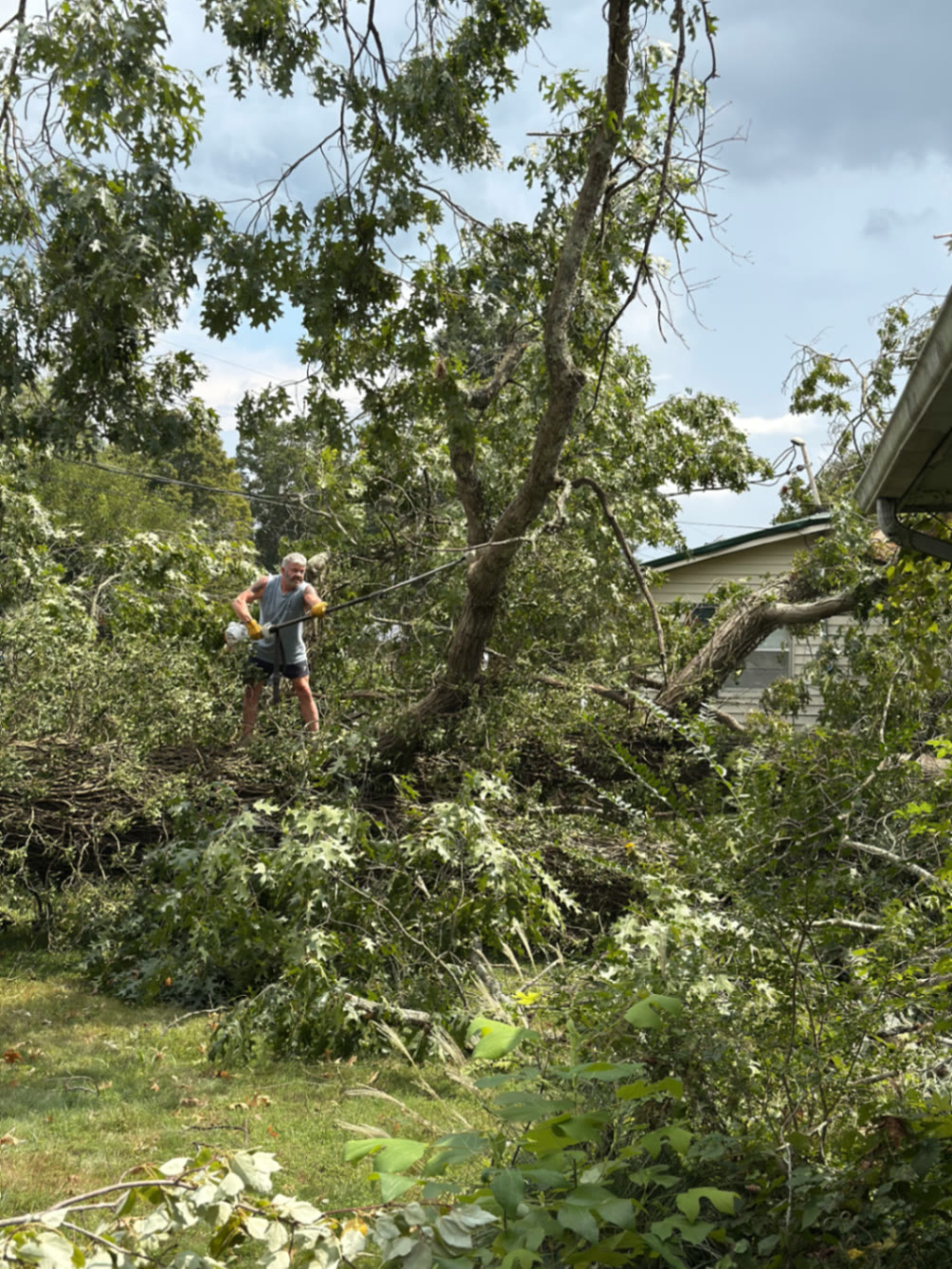
On September 6, 2026, strong winds with gusts around 60 mph moved through the Persia area of Hawkins County. Trees and large limbs came down throughout the area, and at one local residence the storm caused significant damage to the electrical service supplying the home.
This was not simply a case of the power going out for a few hours.
A large tree struck the service area with enough force to damage the overhead electrical connection and place major stress on the electrical equipment attached to the home. The existing service was older, and the impact left physical damage that included cracking in the older fuse equipment. Restoring electricity safely required much more than reconnecting a wire and waiting for the utility to turn the power back on.
The damaged service had to be evaluated, unsafe equipment had to be replaced, grounding and bonding had to be addressed, the service had to be brought into a safe and dependable condition, and the home had to be checked before normal electrical use could resume.
The job ultimately involved a modern 200-amp breaker service, new service equipment, a new weatherhead and related overhead service components, updated grounding and bonding, whole-home surge protection, and the work necessary to reconnect and restore the home's branch circuits safely.
It is a real example of something many homeowners do not realize until they experience it themselves: when a tree hits a power line or tears down an electrical service, the damage can extend far beyond the point where the tree actually landed.
A Tree Hitting a Power Line Is More Than a Power Outage
When most homeowners see a tree lying across an electrical line, the first thought is usually that the power is out and the electric company needs to come reconnect it. Sometimes that really is the extent of the problem. Other times, losing power is only the beginning.
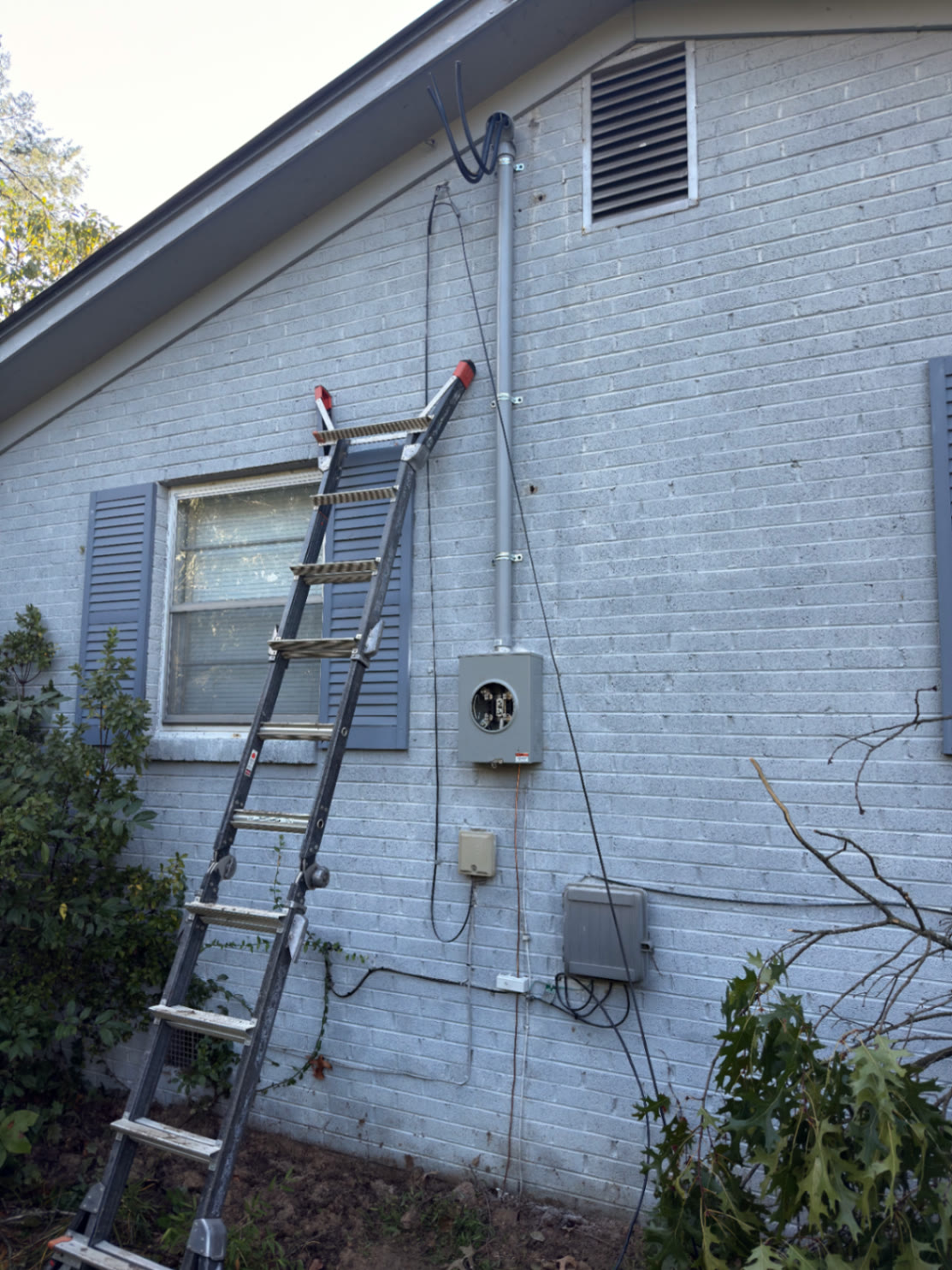
An overhead electrical service is physically connected to the home. Utility conductors travel from the pole toward the building and attach at the service point. When a heavy tree or limb falls across those conductors, an enormous amount of mechanical force can be transferred into the equipment attached to the house.
That force may bend the service mast, pull the weatherhead out of position, loosen the attachment point, damage conduit, stress the meter enclosure, pull on service conductors or damage equipment farther inside the electrical system.
The damage may be dramatic and obvious, but it does not always have to look severe. A meter can still be hanging on the wall while connections inside have been stressed. A mast can look only slightly bent while fittings or supports have been damaged. A panel can appear intact while the service conductors feeding it experienced tremendous mechanical and electrical stress.
That is why storm damage needs to be evaluated as an electrical system problem rather than simply a broken wire.
Never Assume a Downed Power Line Is Dead
One of the most important things any homeowner can understand is that a power line lying on the ground should always be treated as energized.
Do not assume the power is off because the wire is not sparking. Do not assume it is safe because the neighborhood lights are out. Do not assume a breaker or fuse somewhere automatically made everything safe.
Electrical utility systems contain protective equipment that can operate and, depending on the situation, attempt to restore power. Utility crews may also re-energize parts of the system while working through storm damage. That means a conductor that appears dead can become energized again.
If a power line is down, hanging low, caught in a tree or lying across a driveway, stay away from it and keep other people away from the area. Do not touch it with your hands, a stick, a board, a rope, a tool or anything else. Electricity is not something to experiment with.
The Tree Can Become Part of the Electrical Hazard
One of the most dangerous assumptions people make is that the tree itself is safe because wood is not normally thought of as a conductor. Real trees are not dry pieces of lumber sitting on a shelf. They contain moisture and sap. After a storm, the bark, branches and ground may also be wet.
If a tree is touching an energized conductor, parts of the tree can potentially become energized. The ground around the damaged line can also become hazardous because electrical current can travel through soil and create dangerous voltage differences between two points on the ground.
That means the safest place is well away from the damaged line and tree. This is not the time to grab a chainsaw. It is not the time to tie a rope around the limb. It is not the time to try to pull the tree away with a tractor. The electrical hazard needs to be addressed before tree removal begins around damaged power lines.
What Happened in the Persia Area
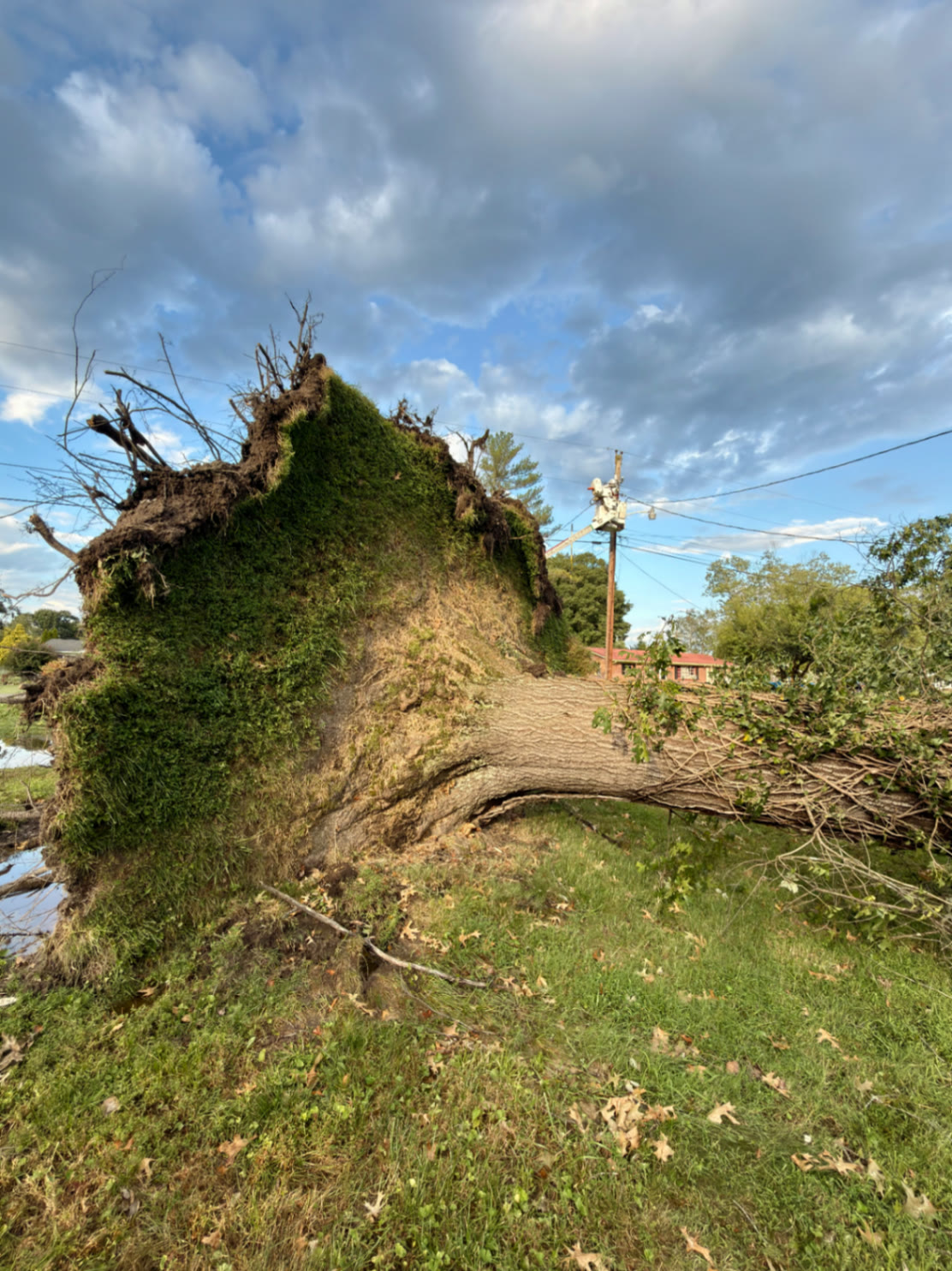
The recent job in the Persia area of Hawkins County is a good example of how quickly a storm can turn into a serious electrical repair. Strong wind brought trees and limbs down around the property, and the electrical service took a direct hit. The impact damaged the overhead electrical connection and existing service equipment. Some of the tree debris had to be cleared simply to establish access to the damaged service.
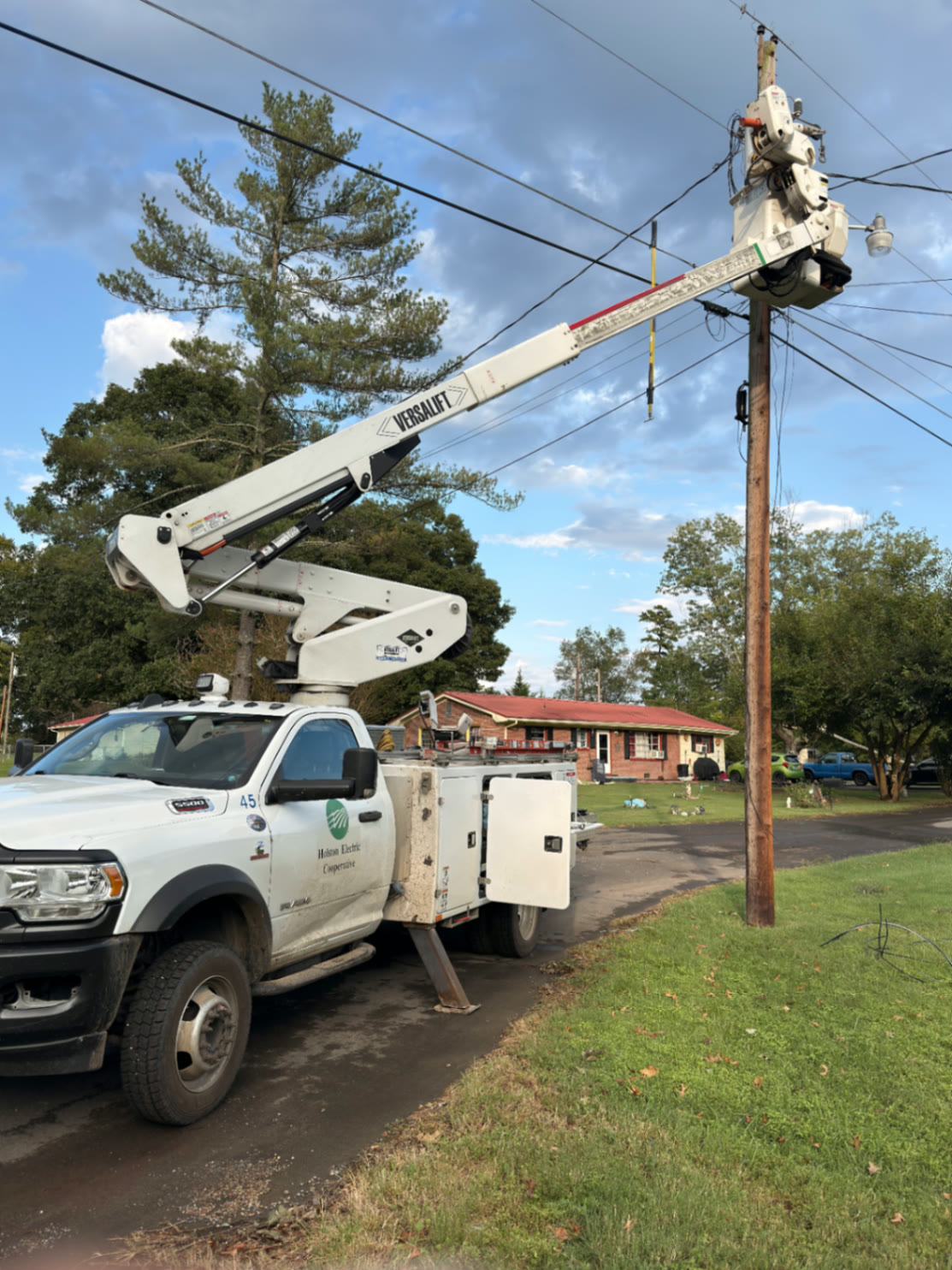
Holston Electric was contacted and the work had to be coordinated in the proper sequence so the utility side and customer-owned electrical equipment could be handled safely.
This is important because the electric utility and the electrician do not necessarily own or maintain the same equipment. The utility may be responsible for its poles, distribution conductors and certain other utility-owned equipment. The property owner is generally responsible for much of the electrical service equipment attached to the home.
Depending on the damage, the utility may first need to disconnect or make the area safe. The electrician can then repair or replace the customer-owned service equipment. Inspection may also be required before the utility reconnects and energizes the repaired service.
Storm restoration often involves several different parties working together. The priority should not be turning the power back on as fast as physically possible. The priority should be turning it back on safely.
How a Tree Can Pull an Electrical Service Away From a House
It is easy to underestimate how much force exists in an overhead service. The utility conductors span through the air and attach to the home. Under normal conditions, the service equipment is designed and supported for the loads it is expected to experience. A falling tree changes the situation instantly.
Imagine several hundred or several thousand pounds of tree moving downward and catching the electrical conductors on the way. Something has to absorb that force. Sometimes the wire breaks. Sometimes the attachment hardware moves. Sometimes the mast bends. Sometimes the meter enclosure pulls away from the wall. Sometimes multiple parts of the service are damaged at the same time.
This is why simply replacing the most visibly broken component may not be enough. The service needs to be looked at as a complete system.
What the Service Mast Actually Does
On many overhead electrical services, the service conductors exit through a weatherhead mounted at the top of a service raceway or mast. Homeowners often see that pipe and assume it is simply conduit protecting wires. Depending on the installation, it may be doing considerably more than that.
The mast and attachment area can be subjected to mechanical force from the overhead service conductors. Wind already places stress on the service during normal weather. Ice can add weight. Tree limbs can pull on conductors. A complete tree falling across the service can create forces far beyond normal operating conditions.
If a service mast is bent or leaning after a storm, pushing it back into place is not a proper repair. The raceway may be damaged. Fittings may have cracked. Supports may have loosened. Conductors inside may have been pulled. The weatherhead may have shifted. The equipment needs to be inspected before it is assumed to be safe.
The Weatherhead Matters Too
The weatherhead is located near the top of many overhead electrical services and helps protect the service raceway from the weather while allowing the service conductors to exit. After a major tree strike, the weatherhead may become cracked, broken or pulled out of position.
That matters because water and electrical equipment do not mix. Once the service has been physically damaged, rainwater may be able to enter areas that were previously protected. Water can travel down conductors and raceways and eventually reach electrical equipment. A service repair after a major storm therefore needs to address both electrical damage and weather protection.
Meter Damage Is Not Always Obvious
The meter enclosure is another place where damage can hide. Homeowners often look at the round meter itself and think everything is okay because the glass is not broken. The meter socket behind it can still be damaged. The enclosure may have twisted slightly. Mounting hardware may have loosened. Conductors may have been pulled. Connections inside may have been stressed.
Electrical service connections carry substantial current, and loose connections can generate heat. Heat leads to deterioration. A connection that was tight before the storm may not necessarily remain tight after the entire enclosure has been subjected to a violent pull. That is why a physically stressed meter enclosure should be evaluated even if it does not look completely destroyed.
A Damaged Neutral Can Create Serious Problems Inside the House
One of the most serious electrical problems that can happen during a storm is a damaged or open neutral conductor. Most residential services supply approximately 120/240 volts. Many appliances and circuits in the home operate at 120 volts and rely on the neutral conductor.
If that neutral becomes loose, damaged or completely disconnected, the voltages on the two sides of the electrical system can become unbalanced. This can create symptoms that seem strange if you do not know what is happening. Some lights may become unusually bright. Others may become dim. Lights may change brightness when the refrigerator, microwave, dryer or another appliance starts. Electronic devices can behave unpredictably. Some appliances may receive higher-than-normal voltage while others receive lower voltage. That can damage electronics very quickly.
If a storm has just occurred and you notice lights becoming dramatically brighter or dimmer throughout different areas of the home, do not treat it like an ordinary light bulb problem. That may be a sign of a service or neutral issue that needs immediate attention.
A Tree Strike Can Cause Electrical Surges
The physical damage is only one part of the story. When trees strike utility lines, conductors may move, make contact, break or create fault conditions. Utility protective equipment can operate. Parts of the electrical distribution system may be switched off and back on as crews work to restore power. Lightning may also be occurring during the same storm. All of these events can create abnormal electrical conditions.
Modern homes contain an enormous amount of sensitive electronic equipment. Your HVAC system may have electronic control boards. Your refrigerator contains electronics. So does your range. Your washing machine and dryer may contain electronic controls. Your garage door opener has electronics. Your television, router, computers, security cameras, smart-home equipment and LED lighting all depend on sensitive components. A storm-related electrical event can potentially affect many different devices at the same time.
Why Whole-Home Surge Protection Is Worth Considering
A whole-home surge protective device is designed to help limit transient overvoltage entering or occurring within the electrical system. It does not make the home immune to lightning or guarantee that every piece of equipment will survive every electrical event. Nothing can make that promise.
What whole-home surge protection does is add another layer of defense. Instead of protecting only a television or computer plugged into a small surge strip, a properly installed whole-home surge protective device can help protect equipment throughout the home's electrical system. That includes equipment that cannot simply be plugged into a power strip, such as HVAC systems and many major appliances.
When a service is being replaced or modernized after storm damage, it is an excellent time to evaluate whether whole-home surge protection should be included.
Damage Can Continue Beyond the Service Equipment
Another important lesson from the Hawkins County storm job is that restoring the service outside does not automatically mean everything inside the home survived the event. Following the electrical event, some receptacle equipment was no longer operating normally. Thermal imaging also identified elevated heat associated with the refrigerator, which meant that equipment deserved additional attention rather than simply assuming everything was fine because electricity had been restored.
That distinction is important. An electrician can restore and evaluate the electrical service supplying the home. That does not automatically prove that every refrigerator, television, HVAC board, appliance or electronic device survived the original event without damage. Those pieces of equipment may need their own evaluation.
Electrical Damage Can Be Immediate or Delayed
Some electrical damage is obvious. A television may never turn back on. A control board may fail immediately. A breaker may trip and refuse to reset. Other damage can be much harder to recognize.
Electronic components can sometimes be stressed without failing instantly. A motor may begin operating hotter. A control board may continue working but become intermittent. An appliance may run differently than it did before the storm. Days or weeks later, it may finally fail completely.
That is why the timing of unusual equipment behavior matters. If multiple devices begin acting differently immediately following the same electrical event, make a note of it. That information can be important when the equipment is later evaluated.
Thermal Imaging Can Help Identify Problems
One tool that can be useful after electrical work or an abnormal electrical event is thermal imaging. A thermal camera allows an electrician to compare the temperatures of electrical equipment, connections and certain loads while they are operating. It does not automatically diagnose every problem, but unusual heat can provide valuable information.
A connection running much hotter than similar connections may deserve investigation. A piece of equipment operating significantly hotter than expected may also need further evaluation. Thermal imaging can help identify conditions that are not always obvious through a visual inspection alone. It is another example of why electrical troubleshooting involves more than simply asking whether something turns on.
Refrigerators, Appliances and HVAC Equipment Deserve Attention After a Surge
Modern refrigerators can contain compressors, electronic control boards, relays, fans, sensors, displays and other electronic components. An abnormal electrical event can affect those parts in different ways. The refrigerator may stop working completely. It may continue cooling but begin running unusually hot. The compressor may cycle differently. Controls may behave strangely. Electronic displays may stop functioning.
The same applies to many other appliances. A modern washing machine may have several electronic boards. A modern HVAC system may have sophisticated communicating controls and variable-speed electronics. As our homes become more electronically controlled, the financial impact of electrical surges can become much greater.
Heating and cooling equipment is one of the most expensive systems in most homes. After a significant storm or service event, pay attention to how the HVAC system behaves. Does it start normally? Is it making different sounds? Does the thermostat communicate correctly? Does the outdoor unit operate? Is the blower functioning normally? A storm does not automatically mean every later HVAC failure was caused by an electrical surge, but unusual behavior beginning immediately after the event should not be ignored.
What Happens When Power Comes Back On
A lot of attention is placed on the moment the power goes out. The moment it comes back on deserves attention too. When the utility finishes enough repair work to restore the circuit, your home may suddenly be energized again.
Look and listen. Do the lights appear normal? Are some unusually bright or dim? Does the HVAC equipment start properly? Do you smell anything burning? Are breakers tripping? Are appliances making unusual noises? Is anything buzzing? Did some equipment remain dead even though the rest of the house came back on?
If something does not seem right, do not assume it will fix itself. Turn off affected equipment when it can be done safely and have the situation evaluated.
Do Not Keep Resetting Breakers
A circuit breaker exists for a reason. If a breaker trips during or after a major electrical event, resetting it once may tell you whether the condition was temporary. If the breaker immediately trips again, stop resetting it.
Repeatedly forcing a breaker back on does not repair damaged wiring or equipment. It can make a dangerous condition worse. A breaker that will not remain on could indicate a damaged circuit, damaged appliance, short circuit, ground fault or another problem that needs to be identified. Leave it off and have it checked.
What If the Meter or Service Is Hanging Off the House?
If service equipment has physically pulled away from the house, treat it as a serious electrical hazard. Do not touch the meter enclosure. Do not attempt to push it back. Do not straighten the mast. Do not grab the conduit. Do not attempt to reconnect conductors. Call the utility and a qualified electrician.
The utility may need to disconnect power before customer-owned equipment can be repaired safely. Once the electrician completes the repairs, an electrical inspection may be required before the utility reconnects service. The process can take coordination, but that is far better than energizing damaged equipment.
Tree Damage Can Affect the Electrical Panel Too
A severe service event does not necessarily stop at the outside wall. The service conductors eventually feed the main electrical equipment. If there is a major surge, damaged neutral, fault or physical pull on the conductors, the electrical panel should be considered as part of the inspection.
In the recent Persia-area job, the older fuse equipment showed physical cracking associated with the storm event. Equipment with structural damage should not simply be ignored because it is still technically carrying electricity. Electrical panels contain energized parts, bus connections, overcurrent devices and conductor terminations. Their physical condition matters.
When equipment has experienced a major storm event and is already outdated or deteriorated, replacement can sometimes make more sense than attempting to rebuild an obsolete installation.
Why the Service Was Upgraded
Major storm damage often forces a homeowner to make decisions quickly. If the existing service is already old, damaged, undersized or obsolete, reinstalling the exact same type of equipment may not be the best long-term solution.
The recent Hawkins County job was restored with a modern 200-amp breaker service. The work also included updated grounding and bonding, modern service equipment and surge protection. That approach does more than simply restore electricity. It gives the home a modern electrical service that is easier to maintain, easier to protect and better suited to today's electrical loads.
Any service upgrade still needs to be based on the home's load requirements, utility requirements and applicable electrical code. The goal should always be installing what the property actually needs.
Grounding and Bonding Matter After Storm Damage
Grounding and bonding are sometimes treated like small details at the end of a service installation. They are not. They are fundamental parts of the electrical system.
A major tree strike can pull on grounding electrode conductors, loosen connections or damage components associated with the electrical service. When service equipment is being replaced, the grounding and bonding system should be evaluated as part of the work. This can include grounding electrodes, grounding electrode conductors, bonding connections and other components depending on the particular home. A properly designed service should be treated as one complete electrical system.
Homeowners often see two ground rods outside a newer service and assume that those rods alone protect the house from lightning. Ground rods are part of the grounding electrode system, and they have to be properly installed, spaced and connected according to the requirements that apply to the installation. Ground rods do not replace proper bonding. They do not replace surge protection. And they do not make a house lightning-proof. Good electrical protection comes from having the entire service designed correctly.
Who Is Responsible for Repairing Storm Damage?
This can become confusing quickly. A tree falls. The power line is down. The homeowner calls the utility. The utility says part of the service belongs to the homeowner. The homeowner calls an electrician. This is normal.
The dividing point between utility-owned and customer-owned equipment depends on the particular utility and service arrangement. In many cases, the utility is responsible for its distribution system and certain conductors supplying the property, while the homeowner is responsible for service equipment attached to the building. If both sides are damaged, both the utility and electrician may be needed. An electrical inspector may also become involved depending on the extent of the repair.
Major electrical service repairs are different from replacing a broken receptacle. When a service is substantially rebuilt or replaced, permitting and inspection requirements may apply. That protects everyone involved. The electrician installs the service. The inspector verifies that the installation meets applicable requirements. The utility then has assurance that customer-owned equipment is ready before it is energized. It may add steps to the process, but restoring power safely is more important than restoring it carelessly.
Tree Removal Comes After Electrical Safety
When a tree is lying across a driveway or house, everyone wants it gone. That reaction is understandable. But if electrical conductors are involved, the order of operations matters.
The electrical hazard should be addressed first. Once the utility determines the lines are safe and the electrical situation is controlled, tree crews can work without the same electrocution risk. Trying to cut a tree away from an energized conductor can turn property damage into a life-threatening emergency.
Be Careful With Generators During Storm Outages
Extended outages often lead homeowners to pull portable generators out of the garage. Generators can be extremely useful, but they need to be connected correctly. A generator should never be connected to a home using an improvised cord intended to backfeed a receptacle. That can energize conductors in dangerous and unintended ways. It can endanger the homeowner. It can endanger electricians. And it can endanger utility workers trying to restore power.
A home intended to operate from a generator should have proper transfer equipment or another approved connection method designed for that purpose. Generators also produce carbon monoxide and must be operated outdoors in a safe location away from doors, windows and other openings.
What Homeowners Should Watch for After a Storm
Even if the utility restores power and the outside service looks normal, pay attention to the way the electrical system behaves afterward. Unusual brightening or dimming of lights, appliances that suddenly stop working, breakers repeatedly tripping, burning odors, buzzing sounds, partial power, HVAC problems, garage door opener failures, damaged electronics or unusual heat from equipment can all be reasons to investigate further.
The key is a change from normal operation. If something worked normally before the storm and immediately begins behaving differently afterward, that information matters.
Document Serious Storm Damage
Photographs are extremely useful after a major electrical event. Take pictures of the tree. Take pictures of the damaged electrical service. Photograph visible damage to the meter, mast, panel, siding and surrounding property. Make a list of appliances and electronics that are no longer operating normally.
Write down approximately when the storm occurred and when electrical problems were first noticed. Keep electrical invoices, repair documentation and inspection records. If an insurance claim is involved, having good documentation can make it much easier to explain exactly what happened and what repairs were necessary.
Prevention Starts Before the Storm
No homeowner can completely prevent a tree from falling during a severe storm. But you can reduce some obvious risks. Look at the trees around your electrical service and utility lines. Dead limbs hanging directly above the service deserve attention. A tree that has begun leaning toward the conductors may become a future problem. Branches constantly rubbing electrical lines should not simply be ignored.
Do not attempt to trim trees close to energized utility conductors yourself. Contact the utility or a qualified tree professional trained to work around electrical systems. A little preventative work can be much easier than dealing with an electrical service torn from a house during a nighttime storm.
East Tennessee Homes Face Unique Challenges
Our area has a combination of conditions that make storm-related electrical damage particularly relevant. We have large mature trees. We have heavily wooded properties. We have rural roads. We have overhead electrical services. We have mountains and uneven terrain. We have strong thunderstorms, heavy rain, lightning and wind.
Many homes also sit a significant distance from the road, sometimes with barns, garages, wells, workshops and other electrical systems located throughout the property. When trees begin falling, there can be much more involved than one line running to one house. That is why homeowners throughout Hawkins County and surrounding East Tennessee communities should understand what they are looking at when a storm damages electrical equipment.
Restoring Power Is Not the Same as Restoring Safety
This may be the most important takeaway from the entire job. Getting the lights back on is not the only goal. The service needs to be structurally secure. Conductors need to be properly connected. The neutral needs to be intact. Grounding and bonding need to be correct. Damaged equipment needs to be replaced. The electrical panel needs to be safe. Any abnormal equipment inside the home needs to be evaluated. Only then can the electrical system be considered properly restored.
The storm that moved through the Persia area of Hawkins County is a good example of why this matters. A tree strike damaged the electrical service and created a situation that required utility coordination, tree clearing, service replacement, grounding and bonding work, a new breaker panel, surge protection and a complete effort to restore the home safely. The work was not simply about replacing what could be seen from the yard. It was about understanding how the entire electrical system had been affected.
At Trent Electrical, we provide electrical service repairs, service upgrades, meter and mast work, grounding and bonding, breaker-panel replacement, surge protection and storm-damage troubleshooting throughout Rogersville, Hawkins County and surrounding East Tennessee communities.
If a tree or severe storm has damaged the electrical service on your home, stay away from downed lines and contact the utility first when utility conductors are involved. Once the electrical hazard has been controlled, the damaged customer-owned equipment can be properly evaluated and repaired.
A tree may only take seconds to bring an electrical service down, but restoring that service correctly means checking everything the event may have affected—not simply getting the lights back on.