Outside Electrical Meter Services: Location, Height, Service Masts, Grounding and What Homeowners Should Know
If you walk around the outside of almost any home in East Tennessee, you'll eventually find one of the most important parts of its electrical system: the electrical service.
Most homeowners simply call it "the meter."
But the round utility meter mounted outside the house is only one part of a much larger system.
Depending on the property, an outside electrical service can include the utility service drop or underground service conductors, attachment point, weatherhead, service mast or raceway, meter socket, service-entrance conductors, main disconnect or emergency disconnect, grounding electrode system, bonding components, and ultimately the electrical panel that distributes power throughout the building.
Every one of those pieces has a job.
And where those components are located matters.
The height matters.
The strength of what they are attached to matters.
Clearance from roofs, driveways, doors, windows, decks and other areas can matter.
Accessibility matters.
Grounding and bonding matter.
And something many homeowners do not realize is that the electric utility's requirements matter too.
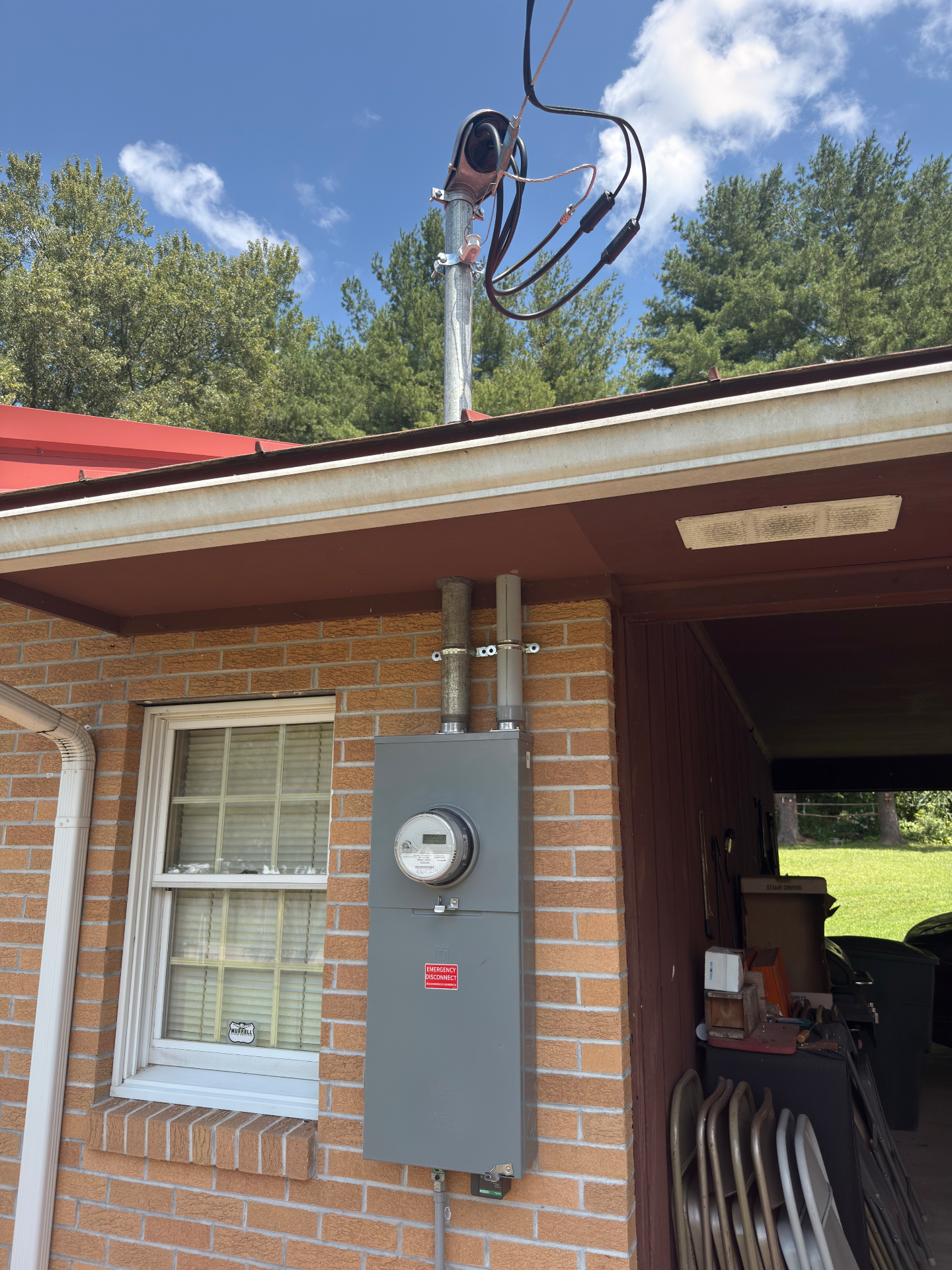
The service shown with this article is from an electrical project we completed in Del Rio, Tennessee. It is a good example of why electrical service work requires planning before conduit ever goes on the wall.
Let's break down how an outside electrical service works, the different situations electricians encounter in East Tennessee, and some of the things that should be considered before installing, relocating or upgrading one.
The Electrical Meter Is Only One Part of the Service
It is easy to look at the meter and assume that is where electricity begins entering your home.
There is more happening before that point.
Electricity is supplied by the utility through either an overhead service or an underground service.
With an overhead service, utility conductors typically run from a utility pole to an attachment point at the building.
With an underground service, conductors approach the meter equipment from below instead.
The utility meter measures the amount of electrical energy being consumed.
After the metering point, electricity continues through the service equipment and eventually reaches the electrical panel, where circuit breakers distribute power throughout the home or building.
That means the outside equipment is not simply there to hold the electric meter.
It is part of the transition between the utility's electrical distribution system and the customer's electrical system.
Overhead Electrical Services
Overhead services are extremely common throughout rural East Tennessee.
Drive through Del Rio, Newport, Rogersville, Greeneville, Bulls Gap, Mooresburg or many of the surrounding rural communities and you will see overhead electrical services everywhere.
The concept looks simple.
A utility pole is located somewhere near the property.
Conductors leave the pole.
They travel through the air toward the house.
They attach to the structure.
The electrical service enters the building.
But designing that correctly involves several considerations.
The conductors have to maintain required clearances.
The attachment point has to be structurally capable of supporting the service.
The weatherhead has to be positioned correctly.
The mast or raceway has to be properly supported.
Water needs to be prevented from entering the electrical equipment.
The meter has to be accessible.
And the installation has to meet the requirements of the serving utility and applicable electrical codes.
So simply finding an empty section of exterior wall and mounting a meter there is not necessarily an acceptable service design.
What Is the Weatherhead?
Look at the top of many overhead electrical services and you will see a hood-shaped fitting.
That is the weatherhead, sometimes called a service head.
It has a simple but extremely important purpose.
The service-entrance conductors need to exit the raceway while helping prevent rainwater from traveling directly into that raceway.
The conductors coming from the weatherhead are arranged so the utility can make its connections to the service drop.
The configuration also helps allow proper drip loops.
Why Are There Loops in the Wires?
Those loops are not there because somebody left too much wire.
They are intentional.
They are called drip loops.
Water follows gravity.
Without proper conductor arrangement, rainwater traveling along a conductor could potentially move toward electrical equipment.
A drip loop allows the conductor to dip below the connection so water can drip from the lowest point rather than being encouraged toward the service raceway.
It is one of those small details that does not look particularly important until you understand what it is doing.
What Is an Electrical Service Mast?
Sometimes an overhead service needs additional height to maintain proper clearance.
That is where a service mast may come into the picture.
A service mast is not simply a piece of conduit sticking above the roof.
Depending on the installation, the mast may be subjected to mechanical forces from the utility service conductors.
That means the type of raceway, attachment method, supports and structural installation become extremely important.
Wind, ice, conductor tension and movement can all place force on a service mast.
This is why an overhead service mast should never be treated like ordinary conduit.
Why Service Height Matters
One of the most common questions about an outside electrical service is: How high is the meter supposed to be?
There is not one responsible answer that says every electric meter everywhere must be exactly one height.
The serving utility has requirements for its metering equipment, and those requirements can vary.
The bigger issue is understanding why height matters.
The utility needs to be able to safely access the meter.
An electrician may need to service equipment.
The meter cannot be located so high that normal access becomes unreasonable.
But it also should not be placed where normal activity around the property creates unnecessary risk.
That is why the meter location should be planned before the service is installed.
Service-Drop Height Is Different From Meter Height
This distinction is extremely important.
The height of the meter and the clearance of the overhead service conductors are not the same thing.
You can have a meter mounted at an acceptable height while still having an unacceptable overhead service drop.
The conductors have to maintain clearance from the surfaces and areas below them.
Those clearance requirements can change depending on what is underneath the service conductors.
A pedestrian-only area is different from a driveway.
A residential driveway is different from an area where larger vehicles or equipment may travel.
That is why the path between the utility pole and the house matters.
A driveway might normally have passenger vehicles underneath the electrical service. But what else uses that driveway? A camper? An RV? A delivery truck? A dump truck? Farm equipment? Construction equipment? A tall trailer?
The electrical service should not be designed only around the vehicle currently sitting in the driveway. The intended and reasonably expected use of the area matters.
A Driveway Can Completely Change the Service Design
Imagine two identical houses.
On the first house, the utility service runs across the front yard where nobody drives.
On the second house, the exact same service route crosses the driveway.
Those installations may require different clearances.
Now imagine somebody later widens the driveway or creates a parking area underneath an existing overhead service.
Something that originally had adequate clearance could become a problem because the use of the area underneath the conductors changed.
That is one reason electrical service planning should include how the property is actually going to be used.
Roofs, Windows, Doors and Decks
Overhead electrical conductors and roofs require careful consideration.
You do not simply want conductors laying across or passing too closely over a roof because that happens to be the shortest route from the pole.
Roof accessibility, slope, conductor location and the type of area below all become important.
This can become an issue when homeowners make additions. Maybe the electrical service was perfectly acceptable when the house was built. Then somebody adds a porch, deck, carport, or attached garage. Suddenly there may be an accessible surface underneath or near conductors that was not there when the original service was installed.
An overhead electrical service also should not be routed wherever it is most convenient without considering building openings.
Windows, doors and other accessible areas can create clearance concerns. Nobody should be able to open a window, stand on an accessible surface or reach out from a building opening and easily contact energized service conductors.
Again, this is why the entire route of an overhead service needs to be planned, not just the location of the meter box.
What About Underground Electrical Services?
An underground service eliminates the overhead service drop from the pole to the building.
For many homeowners, this creates a cleaner appearance.
You do not see wires crossing the yard.
You do not have an overhead attachment or weatherhead in the same configuration as a traditional aerial service.
But underground does not mean simple.
There still has to be a properly designed route between the utility source and the meter.
Depending on the utility and installation, responsibilities for trenching, conduit, conductors and equipment can vary.
Depth, conduit type, bends, sweeps, physical protection and utility specifications all have to be considered.
And before excavation occurs, underground utilities need to be located.
Overhead vs. Underground: Which Is Better?
There is not one answer for every property.
Underground services can look cleaner and eliminate an overhead conductor between the utility source and the house.
They are also not exposed to falling tree limbs in the same way an overhead service drop is.
But underground installations involve excavation and can be more difficult to access if problems develop below grade.
Overhead services are often easier to visually inspect and may be more practical in rural locations.
Terrain also matters. East Tennessee is not flat. Rocky soil, hills, drainage areas, existing utilities, roads and long distances can dramatically affect the practicality and cost of an underground service.
The right choice depends on the property.
Meter Location Matters More Than Appearance
A homeowner may want the meter hidden behind the house because they do not like looking at it.
That is understandable.
But utility equipment has to remain accessible.
Meter readers, utility technicians and electricians may need access to the equipment.
You do not want a meter buried behind a permanent fence, inaccessible deck, landscaping or other obstruction.
The prettiest location is not always the correct location.
Do not plant the meter into a jungle. Landscaping is another issue that develops years after installation. When the service is installed, there may be nothing around it. Then somebody plants a shrub. Ten years later, the shrub is six feet tall and completely surrounds the meter.
Keep electrical service equipment accessible. Do not build permanent structures directly in front of it. Do not stack firewood against it. Do not store equipment around it. And do not allow shrubs or trees to consume the working area.
Electrical equipment needs room for safe operation and maintenance.
What Is the Outside Disconnect?
Modern services may include a disconnecting means outside near the meter.
Depending on the particular installation, you may see equipment labeled as a service disconnect or emergency disconnect.
This gives a means of disconnecting electrical power at or near the service entrance.
That can be extremely important during an emergency.
For example, firefighters or emergency personnel dealing with a damaged structure may need a clearly identified means of disconnecting electrical power.
The exact equipment arrangement depends on the service design and applicable requirements.
Meter-Main Combination Equipment
Sometimes the meter socket and main disconnect are combined into one enclosure.
This is commonly called a meter-main.
These units can create a clean installation by placing metering and service disconnecting equipment together.
From there, conductors may feed an interior panel.
Depending on how the service is configured, that interior panel may then function differently from a traditional panel containing the service disconnect.
That is where grounding and bonding details become especially important.
Grounding Starts at the Service
The grounding electrode system is another major part of electrical service installation.
Depending on the building and what is available, the grounding electrode system can involve several different types of electrodes.
Ground rods are the ones homeowners usually recognize. But they are not necessarily the only grounding electrode associated with a building.
Other qualifying electrodes can include metal underground water piping, concrete-encased electrodes and structural metal under the proper conditions.
The grounding electrode system is intended to work together as a system.
A very common residential installation uses two ground rods. But there is more to the story than simply saying every house needs two rods.
Electrical requirements can vary depending on what grounding electrodes are present and how the grounding electrode system is arranged.
The important takeaway for homeowners is that adding random ground rods does not automatically improve an electrical service. They have to be properly installed and bonded into the grounding electrode system.
Spacing matters. Connections matter. Conductor installation matters. Existing grounding electrodes matter. The entire system has to be considered.
Grounding and Bonding Are Not the Same Thing
These two terms get used interchangeably all the time, but they are different concepts.
Grounding connects parts of the electrical system to the earth through the grounding electrode system.
Bonding creates an electrically continuous path between conductive components.
Bonding is extremely important for fault-current paths.
This distinction becomes particularly important when the main service disconnect is outside and another electrical panel is located inside.
Neutral and equipment-grounding conductor arrangements have to match the way the electrical system is configured.
This is not something that should be guessed at.
What About Older Electrical Services?
East Tennessee has plenty of older homes.
Some still have electrical services that have been in place for decades.
Age alone does not automatically mean a service is unsafe.
But older services deserve inspection.
Things to look for can include rust or corrosion on meter equipment, damaged service-entrance cable, cracked insulation, loose equipment, deteriorated conduit, water intrusion, improperly supported masts, damaged weatherheads, corroded grounding connections, improper bonding, obsolete electrical panels, signs of overheating, inadequate service capacity, and previous modifications that were not installed correctly.
Sometimes the original installation was fine, but decades of weather and modifications have changed the situation.
When Should an Electrical Service Be Upgraded?
There is not a rule saying every older service automatically needs replacement.
But there are several reasons a service upgrade may make sense.
Maybe you are replacing a small older electrical panel. Maybe you are adding a large HVAC system. Maybe you are building an addition. Maybe you are installing an EV charger. Maybe you are adding a workshop. Maybe you are converting from gas appliances to electric. Maybe you are installing a hot tub. Maybe the existing service equipment is simply deteriorated.
Before increasing service size, an electrician needs to consider the electrical load and determine what capacity is actually required.
Bigger is not automatically better. It should be properly sized for the building and anticipated loads.
100-Amp, 200-Amp and Larger Services
Homeowners often hear these numbers without knowing what they mean.
The ampere rating refers to the electrical service's capacity.
Many older homes may have smaller services. A 200-amp service is common on modern homes, but larger homes and properties with substantial electrical loads may require something different.
There are also larger residential service arrangements depending on the utility and equipment.
You cannot simply replace a 100-amp breaker with a 200-amp breaker and suddenly have a 200-amp service.
The service conductors, meter equipment, service disconnect, panel and associated equipment all have to be properly rated and installed for the service.
Manufactured and Mobile Homes Can Be Different
Manufactured homes deserve their own discussion because the electrical service arrangement may be different from a conventional site-built house.
The service equipment may be mounted on a pole or other approved structure separate from the home.
Feeder arrangements, disconnect locations and grounding requirements can differ based on the installation.
You should not assume that the same service layout used on a brick house can simply be copied onto a manufactured home.
The property and equipment need to be evaluated.
Pole-Mounted Services
Some properties use a meter and service equipment mounted on a pole rather than directly on a building.
This is common in certain rural applications.
You may see this serving manufactured homes, RV sites, farms, barns, workshops, remote buildings, well equipment, temporary construction power, or properties where the utility service location is far from the building.
The pole itself becomes part of the installation planning. It has to provide adequate structural support and meet utility requirements.
The meter still needs proper accessibility and working space. Grounding still matters. Conductor protection still matters.
And if feeders leave that location for another building, those feeders have their own requirements.
Temporary Construction Services
Before a new house has walls, it may still need electricity.
That is where temporary electrical services come in.
A temporary service may provide power for saws, compressors, chargers and other construction equipment while the building is being constructed.
Temporary does not mean it can be thrown together.
The structure has to be stable. Equipment has to be weather-resistant where required. Grounding has to be installed. Receptacles require proper protection. The utility has to be able to connect its service safely. And the service still has to maintain required clearances.
Barns, Shops and Detached Garages
Detached buildings are extremely common around East Tennessee.
Maybe you have a house and a garage. Or a house and a barn. Or a workshop 200 feet away.
There are several ways power can be supplied depending on the situation.
Sometimes the detached structure is supplied by a feeder from the house. Other times the property's service arrangement is designed differently.
The electrical load, distance, voltage drop, grounding, conductor size, disconnecting means and intended use of the building all need to be considered.
A shop containing welders, compressors and large tools is very different from a small shed with two lights and one receptacle.
Long Rural Driveways Create Their Own Challenges
This is something particularly relevant to our part of Tennessee.
Some homes are hundreds or even thousands of feet from the road.
Getting electricity from the utility distribution system to the house can become a significant part of the project.
Pole locations matter. Underground routes matter. Voltage drop can matter. Easements may matter. Trees and terrain matter. Future access matters.
And the utility needs to be involved early in the process.
If you are building on rural property, do not wait until the house is nearly finished to start thinking about how electricity is going to reach it.
The Utility and Electrician Have Different Responsibilities
This confuses a lot of homeowners.
The electric utility and the electrician are not the same thing.
Depending on the utility and type of service, the utility may own or be responsible for certain equipment and conductors while the property owner is responsible for others.
The exact service point matters.
That division of responsibility can vary by utility and installation.
That is why contacting the serving utility before major service work is so important.
The utility may need to approve the meter location or service route before installation.
Why Utility Approval Matters
Imagine installing an entire meter service on the back corner of a new house.
The conduit looks great. The grounding is installed. Everything is ready.
Then the utility arrives and says: We cannot serve the meter at that location.
Now equipment may have to be moved.
That wastes time and money.
For new construction, major renovations or relocated services, coordinating the service location beforehand can prevent a lot of headaches.
What Happens When a Service Is Relocated?
Sometimes an existing meter has to move.
This can happen because of a home addition, new garage, deck construction, service upgrade, damaged equipment, utility relocation, remodeling, new driveway, clearance problems, changes to the property, or conversion from overhead to underground service.
Relocating a service is not simply moving the meter box a few feet.
Utility conductors may have to be disconnected. New service equipment may be required. Grounding may need to be modified. The interior feeder or panel arrangement may change. Permits and inspections may be required. The utility then has to reconnect or energize the service.
Planning the sequence is important because nobody wants a house without power longer than necessary.
Water Is the Enemy of Electrical Equipment
Outside service equipment lives in the weather.
Rain. Snow. Humidity. Heat. Cold. Wind.
That is why exterior electrical equipment has to be designed and installed for the environment.
Raceways, fittings, enclosures and conductor arrangements have to minimize water intrusion.
Weatherheads, drip loops, proper fittings and sealing methods all contribute to that goal.
If you ever see water inside an electrical panel or meter equipment, do not treat it as normal.
Water and electrical equipment are a bad combination.
Why a Service Needs Structural Support
Look back at an overhead service mast.
The utility conductors are physically attached to the structure.
Those conductors exert force on the attachment.
Wind can add additional force. Ice can add weight. Tree movement can affect overhead lines.
That is why an attachment point should not simply be screwed into whatever exterior material happens to be convenient.
Brick veneer, siding or trim is not necessarily the structural member supporting the service.
Proper attachment needs to transfer the load to a suitable part of the structure.
A service mast that begins leaning away from a house is a warning sign that should be investigated.
Signs Your Outside Electrical Service Needs Attention
Walk outside occasionally and actually look at your service.
You do not need to touch anything. Just visually inspect it from a safe distance.
Watch for a leaning service mast, loose conduit, a damaged weatherhead, service wires hanging unusually low, tree limbs contacting conductors, rusted equipment, meter enclosure pulling away from the wall, broken conduit, exposed conductors, damaged insulation, missing covers, water damage, burn marks, buzzing or unusual sounds, equipment that has shifted after a storm, and grounding conductors that appear broken or disconnected.
If something does not look right, have it evaluated.
Do not climb onto the roof and try to repair utility service conductors yourself.
Storms Are Especially Hard on Overhead Services
East Tennessee thunderstorms bring wind, lightning and falling trees.
An overhead electrical service is naturally exposed to those conditions.
A tree limb can pull on utility conductors. A fallen tree can damage the service attachment. High winds can stress equipment. Lightning can create electrical surges.
If a storm damages your service mast or pulls electrical equipment away from the house, stay away from the area and contact the utility and a qualified electrician.
Even if the power is out, do not assume every conductor is safe.
Consider Surge Protection When Upgrading a Service
If you are already replacing or upgrading service equipment, it is an excellent time to consider whole-home surge protection.
Modern houses contain an enormous amount of sensitive electronics.
HVAC equipment, appliances, televisions, computers, security systems, smart-home equipment and other devices can all be affected by transient overvoltage.
A service upgrade is a good opportunity to evaluate the grounding and bonding system and incorporate surge protection into the overall design.
Every Property Is Different
That is probably the biggest takeaway from this article.
There is not one meter-service design that can simply be copied onto every house.
A small house in downtown Rogersville is different from a home sitting 1,000 feet off the road. A manufactured home is different from a conventional house. A farm is different from a subdivision. An underground service is different from an overhead service. A house with an attached garage is different from one with multiple detached buildings.
A property with an RV, barn, well pump and workshop may require considerably more planning than a basic residential service.
The correct installation depends on the actual property.
Plan the Electrical Service Before Construction Gets Too Far
If you are building a house, garage, shop or other structure, get the electrician and utility involved early.
Determine where the meter will go. Will the service be overhead or underground? Where is the utility source? Will conductors cross a driveway? How high does the attachment need to be? Will a mast be required? Where will the main disconnect be located? Where will the electrical panel go? What electrical loads are planned? Will there be an EV charger later? A hot tub? Large HVAC equipment? A workshop? A future addition? A generator? Solar?
Thinking about these things before construction can save substantial time and expense later.
A Good Electrical Service Is Supposed to Look Boring
A properly installed electrical service often does not look particularly exciting.
That is actually a good thing.
The conduit is straight. The equipment is secure. The meter is accessible. The weatherhead is positioned correctly. The conductors maintain proper clearance. The grounding and bonding are correct. The equipment is rated for the environment. Nothing is hanging loose. Nothing is pulling away from the building. Nothing is installed where somebody is likely to hit it.
And the utility can safely access its equipment.
When an electrical service is properly designed and installed, most homeowners will never have to think about it.
That is exactly what we want.
Electrical Service Work in Del Rio and East Tennessee
The service pictured with this article was completed in Del Rio, Tennessee, and it is a good example of the type of planning that goes into an outside electrical service.
What looks like a meter and some conduit on the side of a building is actually the connection point between a structure and the electrical utility system.
Meter location, service height, conductor clearance, structural attachment, weather protection, disconnecting means, grounding, bonding and accessibility all have to work together.
And because utilities can have their own service requirements, the exact installation needs to be coordinated for the location being served.
At Trent Electrical, we provide electrical service work throughout Rogersville, Hawkins County and surrounding East Tennessee communities, including service upgrades, meter-service installations, electrical panels, grounding, overhead and underground service work, and troubleshooting existing electrical systems.
If you are building a home, adding a garage or shop, replacing an older electrical service, converting from overhead to underground, or simply are not sure whether your existing meter service is installed correctly, it is worth having the entire service evaluated, not just the meter.
Your electrical service is the front door to your home's entire electrical system. It deserves to be designed and installed correctly.